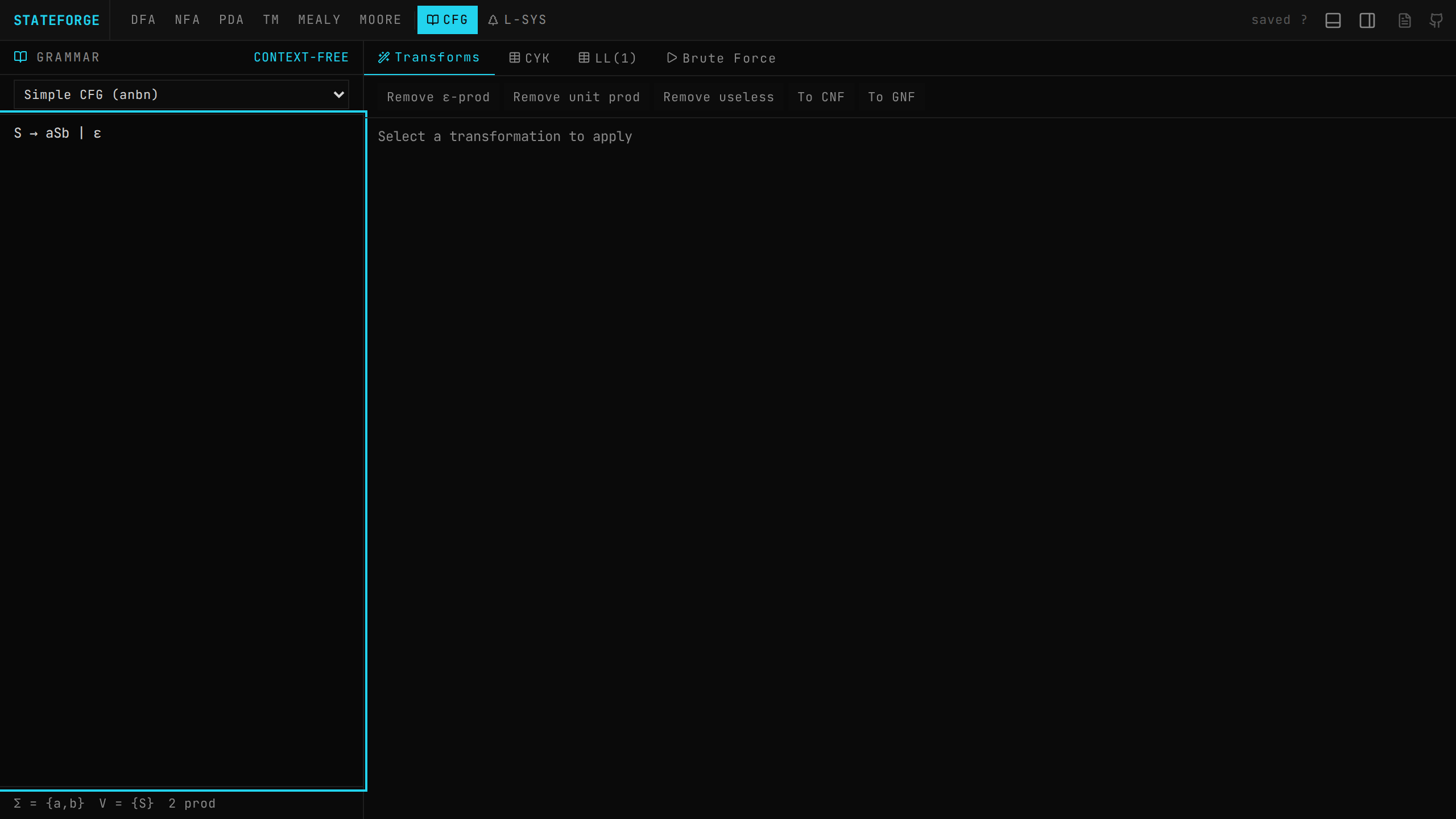
Grammar editor
Press 7 or click CFG in the toolbar to open the grammar editor. It replaces the canvas with a split-pane view: grammar text editor on the left (320px wide on desktop, 40% height on mobile), tools panel on the right.
Grammar syntax
→ Write productions with →, ->, or ::= as the arrow
→ Use | for alternatives on the same line: S → aSb | ε
→ Use ε, eps, epsilon, or ϵ for the empty string
→ Lines starting with # or // are treated as comments and ignored
→ Multi-character non-terminals can be written in angle brackets: <Expr>
→ Uppercase single letters are non-terminals; everything else (lowercase, digits, symbols) are terminals
→ The first production's head becomes the start symbol
Built-in examples
Load from the dropdown:
→ Simple CFG (aⁿbⁿ): S → aSb | ε
→ Arithmetic: E → E+T | T; T → T*F | F; F → (E) | a
→ Balanced Parens: S → (S)S | ε
→ Palindrome: S → aSa | bSb | a | b | ε
Grammar classification
The grammar is automatically classified and shown in the header:
→ Regular — right-linear: each body is a single terminal, a terminal followed by a non-terminal, or ε
→ Context-Free — head is a single non-terminal, body is unrestricted
→ Context-Sensitive — |head| ≤ |body| for all productions (except S → ε)
→ Unrestricted — none of the above constraints hold
The stats bar shows: Σ (terminals), V (non-terminals), and production count.
Transforms
Five standard grammar transformations, each with step-by-step explanations:
→ Remove ε-productions: Finds all nullable non-terminals (those that can derive ε). For each production containing nullable symbols, generates all combinations with those symbols optionally removed. If the start symbol was nullable, re-adds S → ε.
→ Remove unit productions: Finds all unit pairs (A, B) where A ⇒* B through unit productions. Replaces each unit chain with direct productions. E.g., if A → B and B → ab, creates A → ab.
→ Remove useless symbols: Two phases: (1) Remove non-generating symbols (those that can never derive a terminal string), (2) Remove unreachable symbols (those not reachable from the start symbol).
→ Convert to CNF (Chomsky Normal Form): First applies ε-removal, unit-removal, and useless-removal. Then: (TERM) replaces terminals in bodies of length > 1 with fresh non-terminals, (BIN) breaks productions with > 2 body symbols into chains of binary productions.
→ Convert to GNF (Greibach Normal Form): First converts to CNF, then applies a forward pass (substitute lower-ordered non-terminals, remove left recursion by introducing primed non-terminals) and a backward pass (back-substitute so all productions start with a terminal).
Each transform shows intermediate productions at each step. Click APPLY TO EDITOR to replace the grammar text with the result.
CYK parser
The Cocke-Younger-Kasami algorithm for parsing context-free grammars.
→ Auto-CNF: If the grammar is not in CNF, it is automatically converted first
→ Empty string: Handled specially; checks if S → ε exists in the grammar
→ Table display: Shows the triangular CYK table where cell [l][i] contains the set of non-terminals that derive the substring from position i with length l+1. Populated cells show non-terminals in accent color; empty cells show ∅.
→ Parse tree: If accepted, a parse tree is reconstructed via backtracking and displayed as an interactive collapsible tree (click non-terminal nodes to expand/collapse)
→ Steps: Each step shows which substring was analyzed and what non-terminals were found
LL(1) parser
A predictive top-down parser using FIRST and FOLLOW sets.
→ FIRST sets: Computed iteratively until fixpoint. For each non-terminal, determines which terminals can appear as the first symbol of strings derived from it.
→ FOLLOW sets: Computed iteratively. For each non-terminal, determines which terminals can appear immediately after it in some derivation. Start symbol always has $ in its FOLLOW set.
→ Parse table: Displayed as a grid with non-terminals as rows and terminals (plus $) as columns. Each cell shows the production to apply, or "-" for empty.
→ Conflicts: If multiple productions map to the same (non-terminal, terminal) cell, conflicts are listed in red. The grammar is not LL(1) if conflicts exist.
→ Parse steps: A table shows each parsing step with: Stack, Input (remaining), and Action (match terminal or apply production). Limited to 500 steps.
→ Parse tree: If successful, an interactive collapsible parse tree is displayed
SLR(1) parser
A bottom-up shift-reduce parser using SLR(1) parsing tables.
→ Build Table: Click "Build Table" to compute the LR(0) item sets, GOTO function, and SLR(1) ACTION/GOTO table from FIRST and FOLLOW sets.
→ Item sets: The parser first computes the canonical collection of LR(0) item sets using closure and goto operations. Each item set is displayed showing all items (productions with a dot indicating the parser position).
→ ACTION table: For each state and terminal (including $), shows shift (sn), reduce (rn), or accept. Displayed as a grid.
→ GOTO table: For each state and non-terminal, shows the next state. Displayed alongside the ACTION table.
→ Conflict detection: If multiple actions map to the same (state, terminal) cell, conflicts are listed. Shift-reduce and reduce-reduce conflicts indicate the grammar is not SLR(1).
→ Step-through parsing: Enter a string and click "Parse" to see step-by-step shift-reduce parsing. Each step shows the stack contents, remaining input, and action taken (shift, reduce by production, or accept).
Parse tree visualization
CYK and LL(1) parsers display an interactive parse tree when parsing succeeds.
→ SVG tree: The tree is rendered as a collapsible SVG diagram with non-terminal nodes and terminal leaves.
→ Expand/collapse: Click any non-terminal node to collapse or expand its subtree.
→ Layout: Nodes are arranged top-down with automatic spacing. Terminal leaves are shown in accent color, non-terminals in the default text color.
Brute force parser
A BFS exhaustive search parser that works with any grammar type.
→ Algorithm: Starting from the start symbol, applies leftmost derivation: finds the leftmost non-terminal and tries all applicable productions. BFS ensures the shortest derivation is found first.
→ Pruning: Derivations exceeding the max depth (15) are pruned. Sentential forms with more than input.length + 5 terminals are also pruned. Visited forms are tracked to avoid cycles.
→ Output: If accepted, shows the leftmost derivation as a sequence: S ⇒ aSb ⇒ aabb
→ Limitations: Slow for large grammars or long strings due to exponential search space. Best for small examples.